About Hard Water &
Scale Buildup
Learn how dissolved minerals in water form destructive scale deposits that damage pipes, appliances, and industrial equipment — and why understanding this process is the first step toward solving it.
Talk to ExpertBefore & After: Scale in Pipes
See the dramatic difference between scaled and clean pipes
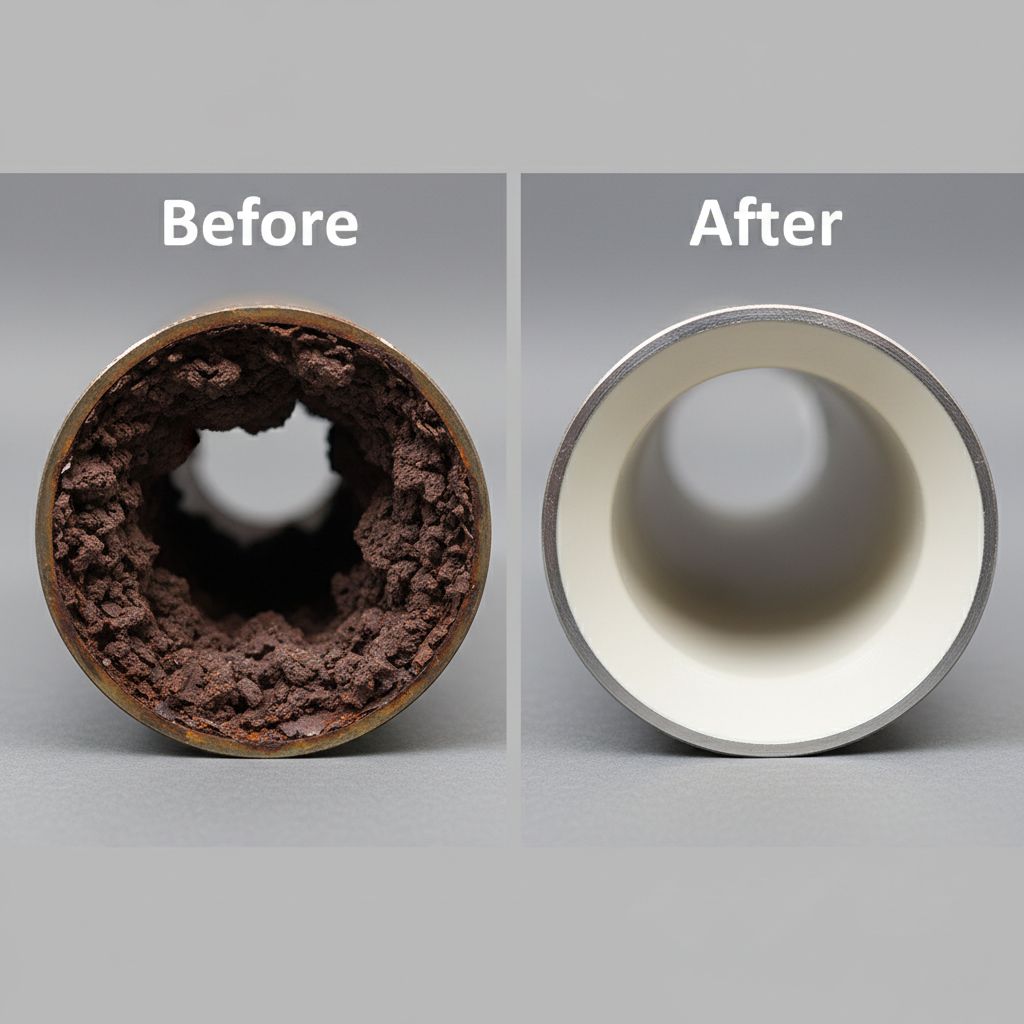
A side-by-side photograph of two cross-sections of metal pipes. The pipe on the LEFT (labelled 'Before') shows the interior completely clogged with thick, dark, crusty mineral scale deposits — almost entirely blocking the water flow path. The pipe on the RIGHT (labelled 'After') shows a clean, open pipe interior with a smooth, light-coloured lining — the full bore of the pipe is visible and unobstructed.
Did you know? Scale buildup can reduce pipe diameter by up to 70%, drastically lowering water pressure and flow. This leads to increased energy costs, frequent maintenance, and premature equipment failure.
How Scale Forms: The Complete Process
The sequential stages that lead from dissolved minerals to destructive scale
Dissolution
Supersaturation
Nucleation & Precipitation
Crystal Growth
Scale Deposit
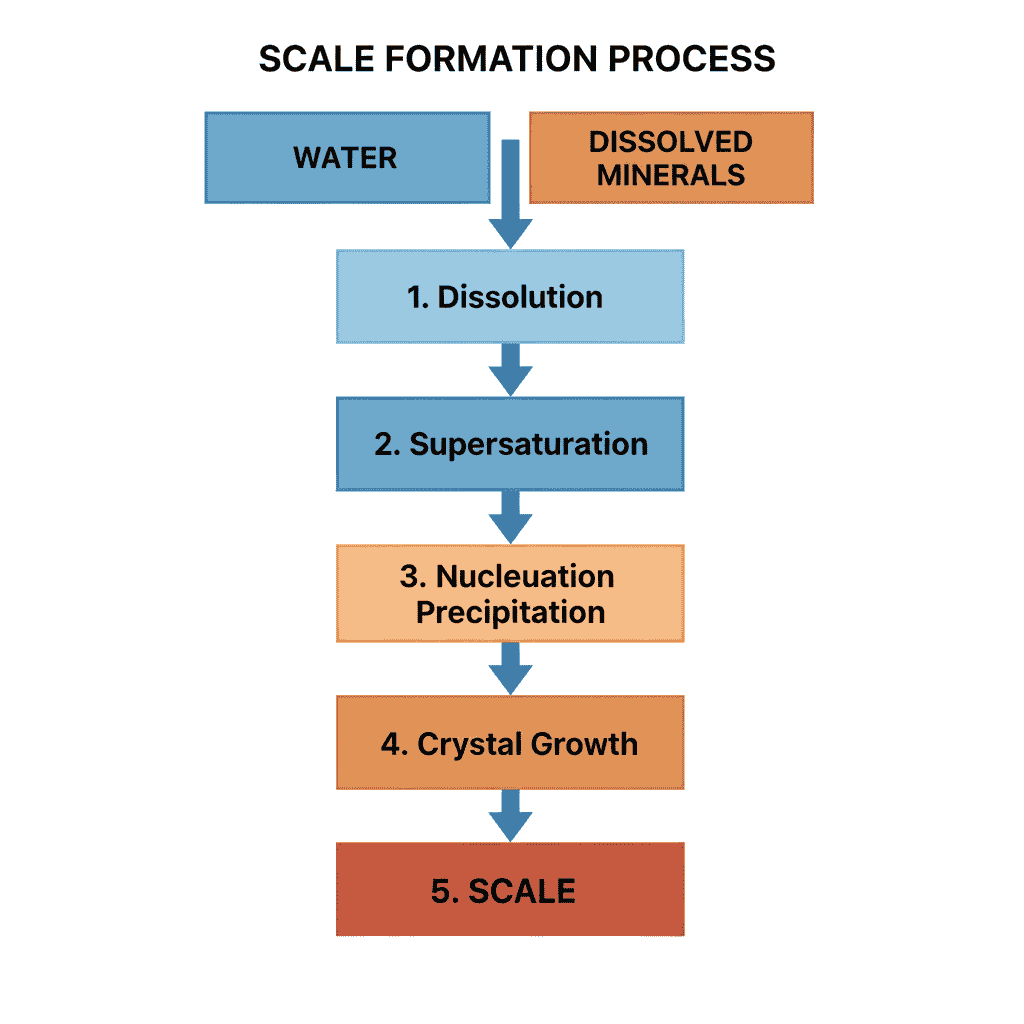
A vertical flowchart diagram showing the sequential stages of scale formation. It begins with two input boxes — 'WATER' and 'DISSOLVED MINERALS' — which merge into a single downward flow through: Dissolution → Supersaturation → Nucleation Precipitation → Crystal Growth → Scale.
Stage 1: Dissolution
How scale (calcium carbonate) enters the water stream
AWater Becomes Acidic
Whenever it rains, water in contact with air absorbs the CO₂ gas present in the atmosphere. This is a natural process that happens continuously — rainwater isn't pure; it becomes slightly acidic as it falls through the air.
The following chemical reaction takes place:
CO₂ + H₂O → H₂CO₃
Carbon Dioxide + Water → Carbonic Acid
This carbonic acid (H₂CO₃) is weak but persistent. It's the first step in the chain reaction that ultimately leads to scale formation in your pipes.
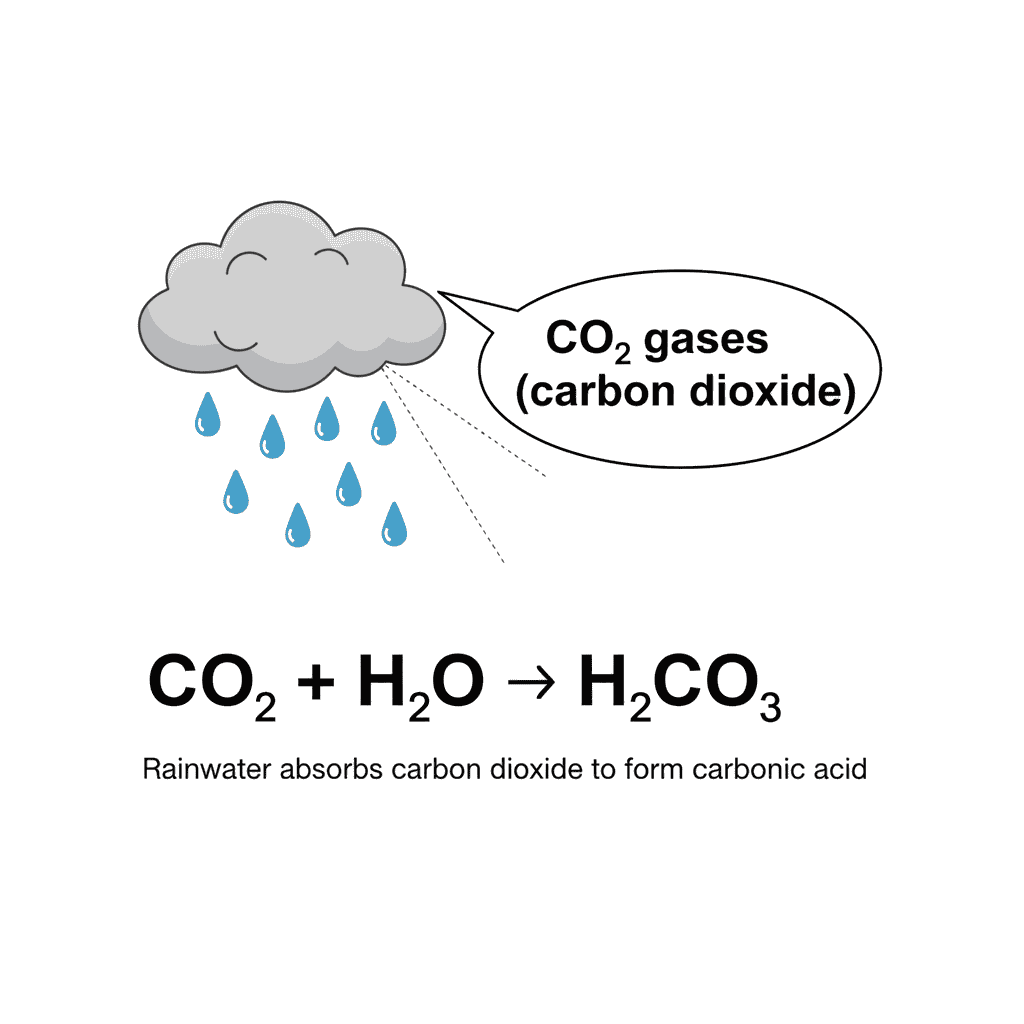
An illustration of a rain cloud with raindrops falling from it. Beside the rain, an oval callout labels the surrounding air as 'CO₂ gases (carbon dioxide)'. Below, a chemical equation: CO₂ + H₂O → H₂CO₃ explains how rainwater absorbs carbon dioxide to form carbonic acid.
BAcidic Water Dissolves Calcium Carbonate
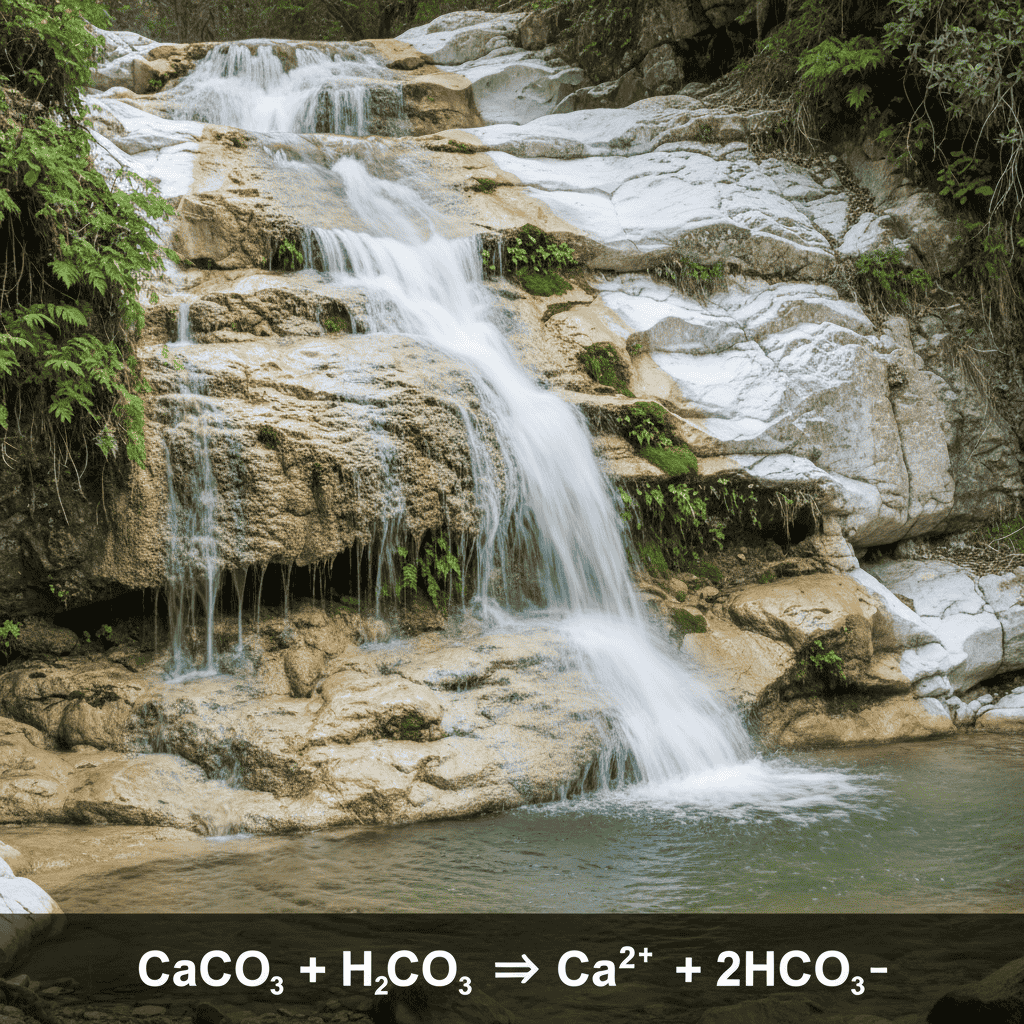
A photograph of a natural waterfall cascading over rocky limestone/marble terrain, illustrating how acidic rainwater flows over and permeates through calcium carbonate-rich rocks, dissolving minerals as it passes through. Below, the chemical equation: CaCO₃ + H₂CO₃ → Ca²⁺ + 2HCO₃⁻.
As the acidic rainwater reaches the earth's surface, it passes over and permeates through rocks such as limestone, marble, and seashells. These are all forms of calcium carbonate (CaCO₃). The carbonic acid slowly dissolves these rocks, forming soluble calcium ions and bicarbonate ions.
CaCO₃ + H₂CO₃ → Ca²⁺ + 2HCO₃⁻
Calcium Carbonate + Carbonic Acid → Calcium Ion + Bicarbonate Ions (in solution)
This is how minerals get into your water supply. The dissolved calcium and bicarbonate ions are invisible — you can't see or taste them — but they are what makes water "hard."
CThree Factors That Cause Scale Precipitation
Any condition that alters the solubility of calcium bicarbonate will result in the precipitation of calcium carbonate — this is what we call scale. There are three major factors:
Temperature Effect
A change from cold to hot water causes scale to form. When temperature increases, CO₂ evaporates from the water, allowing calcium carbonate to precipitate. Heating also causes water evaporation, leaving behind concentrated minerals.
pH Change Effect
Solubility of CaCO₃ decreases with an increase in pH. A lower pH means more acid, which dissolves more calcium carbonate. Conversely, a higher pH reduces solubility, causing calcium carbonate to precipitate as scale.
Pressure Effect
A change from high to low pressure causes scale to form. Pressure drops occur from friction between water molecules, friction with pipe walls, and rough areas in the piping channel. Lower pressure means less dissolved CO₂.
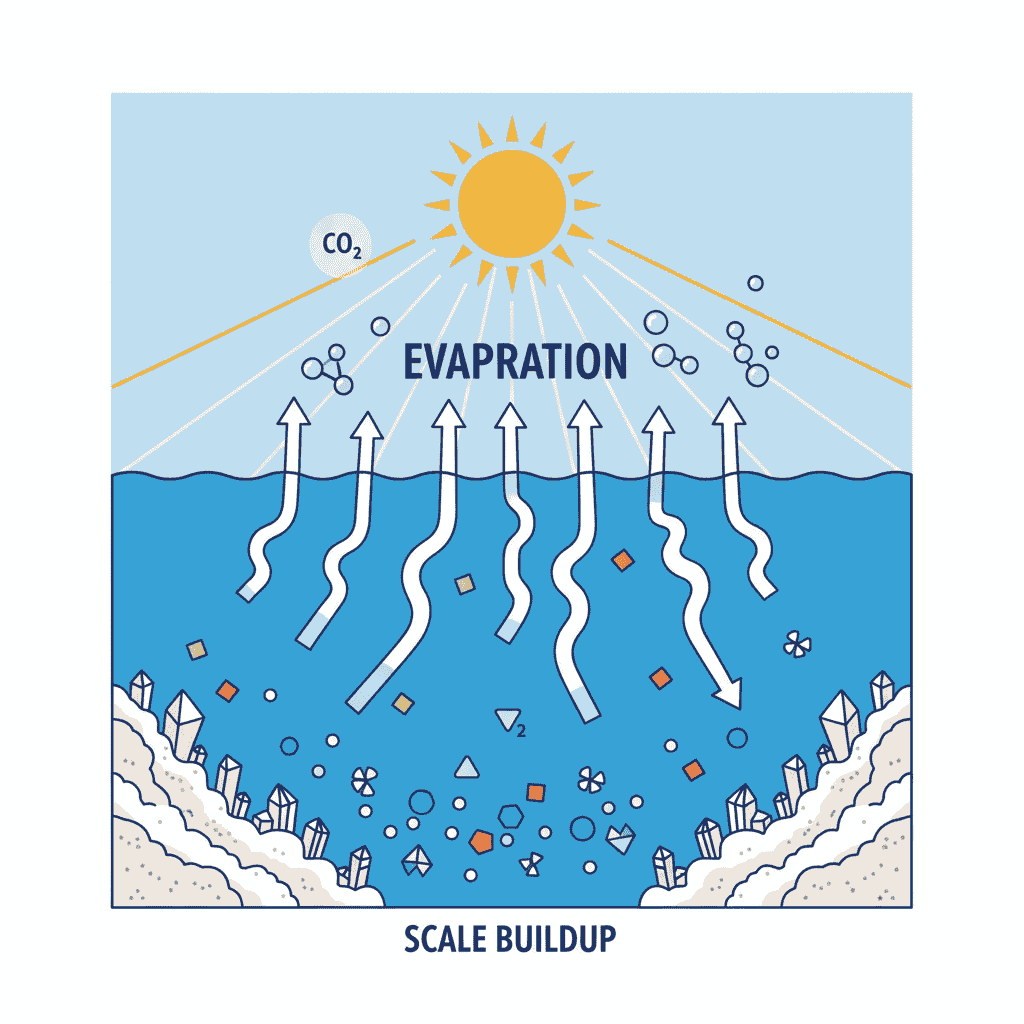
A diagram showing a body of water under sunlight, with wavy upward arrows labelled 'EVAPORATION' rising from the water surface toward the sun. This illustrates how heating water causes CO₂ to evaporate and water to evaporate, concentrating dissolved minerals that then form scale.
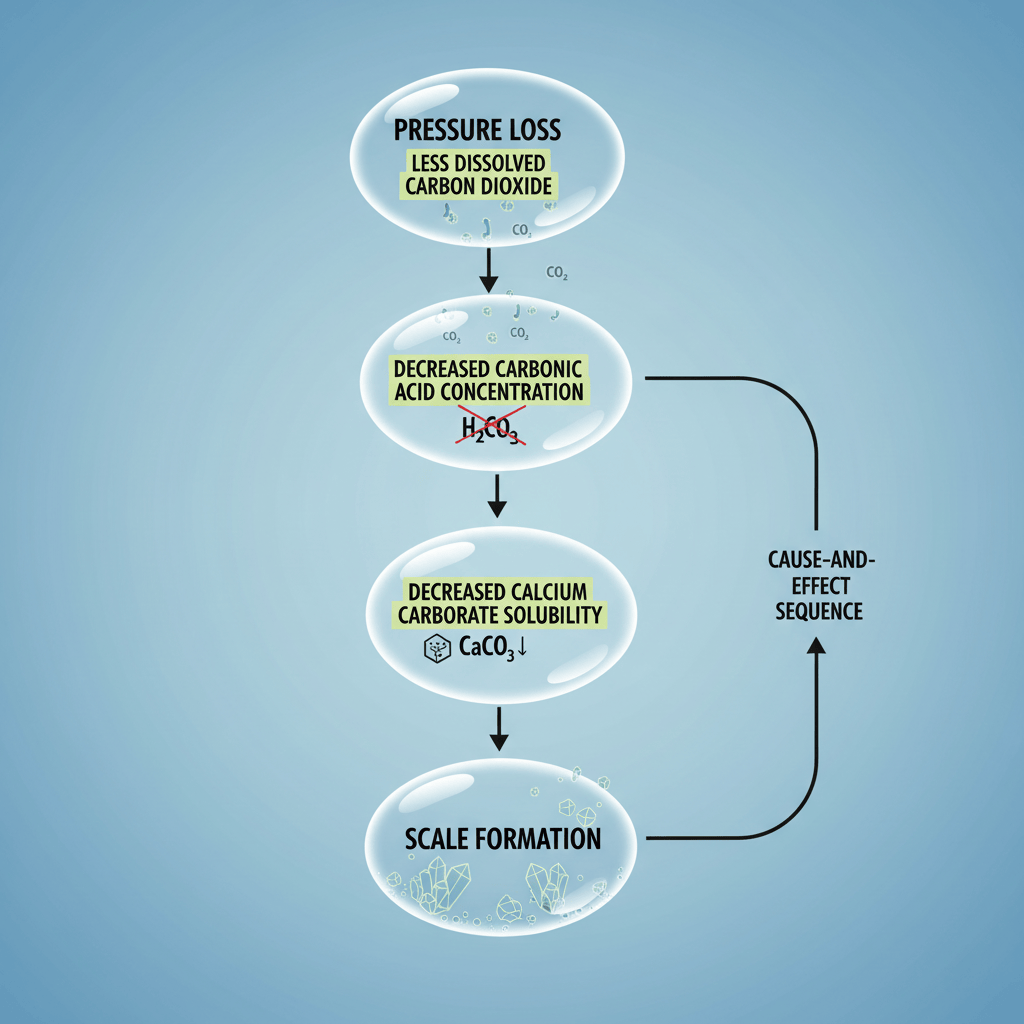
A cascading bubble/oval chain diagram showing the cause-and-effect sequence of pressure loss leading to scale: Pressure Loss → Less dissolved carbon dioxide → Decreased carbonic acid concentration → Decreased calcium carbonate solubility → Scale formation.
Stage 2: Supersaturation
The primary cause of scale deposition
Supersaturation at the point of crystallization is the primary cause of scale deposition.Understanding what supersaturation means is key to understanding why scale forms.
Key Definitions
Saturation
The maximum equilibrium concentration of a compound that will dissolve into a solution under a given set of conditions (temperature, pressure, flow velocity, etc.).
Supersaturation
Solutions that contain higher concentrations of dissolved solute than their equilibrium concentration. In simple terms: scale-causing ions that barely "hang in the water."
When calcium and bicarbonate ions are hydrated, water molecules are attached to these ions via ionic bonds, which are much stronger than the van der Waals force. In a supersaturated solution, these ions are only partially hydrated — the harder the water, the weaker the hydration energy holding the ions in solution.
"In a supersaturated solution, calcium ions are barely 'hanging in water' — their hydration shells are incomplete, making them highly unstable and prone to forming scale."
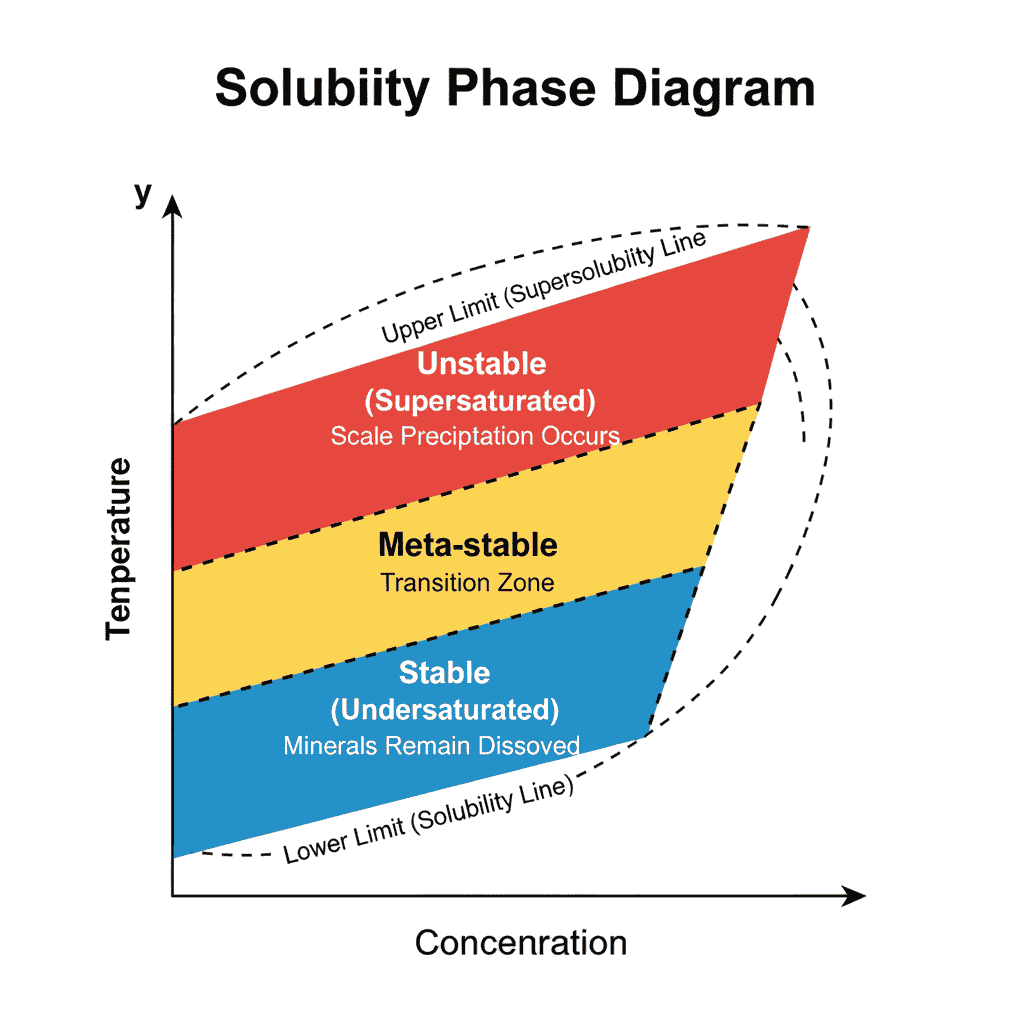
A graph with 'Concentration' on the X-axis showing three diagonal zones: Unstable (Supersaturated) at top where scale precipitation occurs, Meta stable in the middle transition zone, and Stable (Undersaturated) at bottom where minerals remain dissolved.
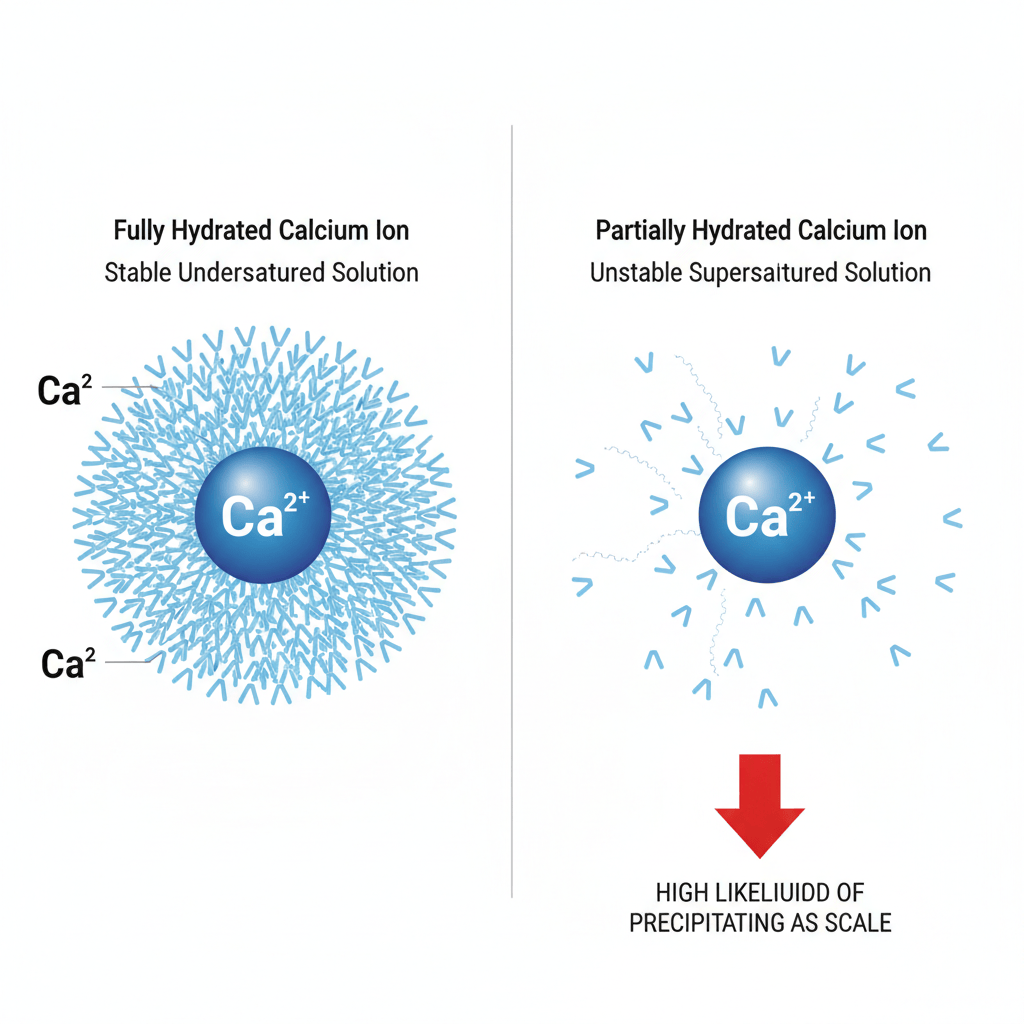
Two side-by-side illustrations of calcium ions. LEFT: 'Fully hydrated calcium ion / stable undersaturated solution' — Ca ion completely surrounded by dense, tightly packed water molecules. RIGHT: 'Partially hydrated calcium ion / unstable supersaturated solution' — Ca ion with fewer, loosely scattered water molecules, indicating weak retention and high likelihood of precipitating as scale.
Stage 3: Nucleation & Precipitation
Why scale sticks to surfaces — it's not gravity!
Why Does Scale Stick to Surfaces?
You may be wondering: when scale forms, why does it stick to surfaces? The answer lies in electrostatic attraction between the metal surface and scale-causing minerals. Gravity plays no role in scale formation.
The unique characteristic of scale deposits is their uniformity. Scale forms evenly around pipe walls because it's driven by the electrical charge difference between the metal and the dissolved minerals. Precipitates formed in one part of a system and carried to another part are less adherent than those crystals formed on site.
Causes of Local Supersaturation
Even when the bulk solution is less than fully saturated, scale can still form due to local supersaturation:
- Increase in temperature
- Increase in pH
- Decrease in pressure
- Agitation of the solution
- Decrease in flow velocity
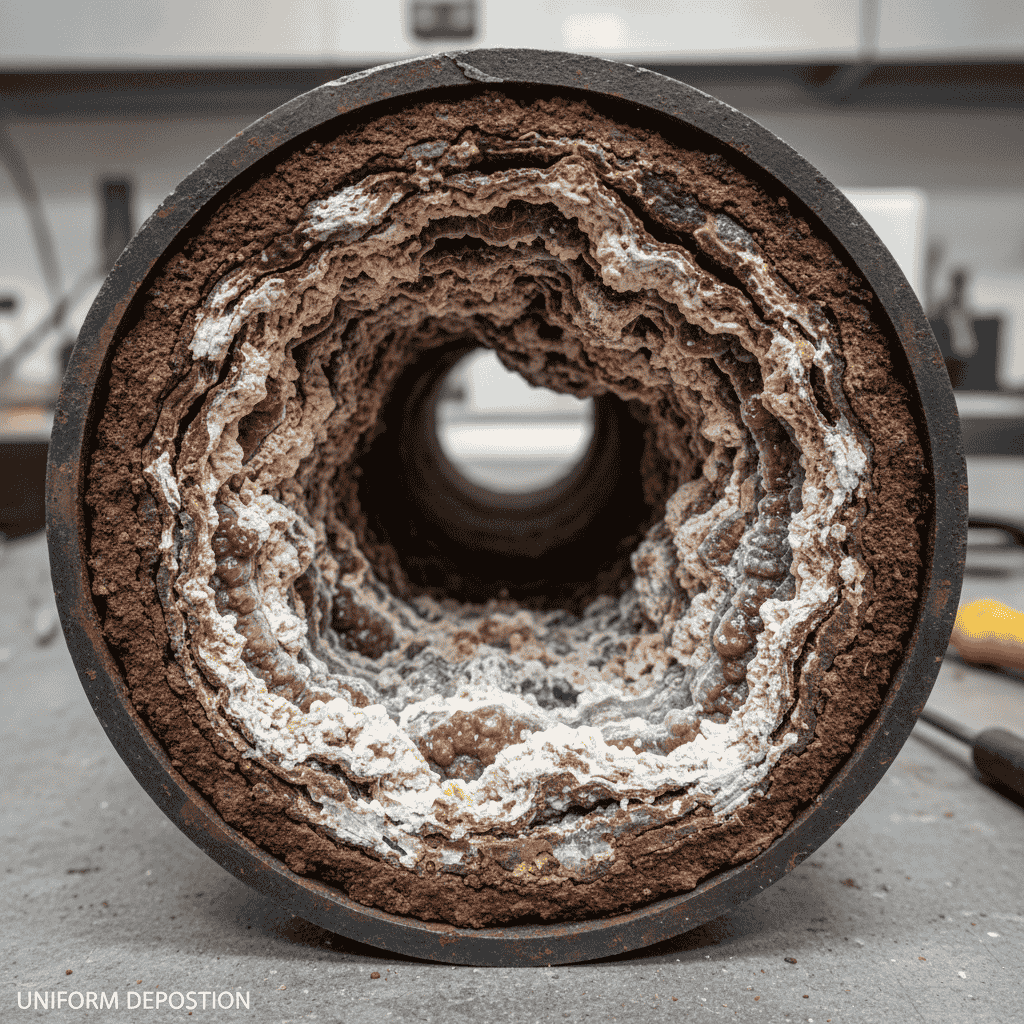
A photograph showing the interior cross-section of a heavily scaled metal pipe. The circular interior bore is almost completely blocked by thick, reddish-brown and whitish mineral scale deposit built up uniformly around the entire inner wall. This illustrates the 'uniform deposition' characteristic of scale — it adheres evenly due to electrostatic attraction rather than gravity.
Electrostatic Attraction — Three Models
The science behind why scale adheres to metal surfaces
Helmholtz Model
When a metal contacts an ionic solution, the metal surface has a high density of electrons (locally negative charge). Solvated positive ions (H⁺, Ca²⁺, Mg²⁺) align along the metal surface, creating an electric double layer. This model does not consider thermal motion of ions.
Gouy-Chapman Model
Due to thermal motion of ions, the population of positive charges (H⁺, Ca²⁺, Mg²⁺) decreases exponentially with increasing distance from the metal surface. This creates a more realistic "diffuse" layer rather than the rigid Helmholtz layer.
Stern Model (Combined)
Combines both models: ions closest to the metal form a rigid Helmholtz plane, while outer ions follow the Gouy-Chapman diffuse pattern. The electric potential difference (coulombs) between these layers is what causes scale to attract and deposit uniformly on surfaces.
Now You Understand the Problem.
Let Us Show You the Solution.
Scale formation is a natural but destructive process. Our Electronic Water Conditioner uses advanced technology to prevent and remove scale — without chemicals, without maintenance.