Our Technology:
Scale Elimination
Discover how our Electronic Water Conditioner uses Induced Molecular Agitation (IMA) and frequency modulation to prevent scale formation and dissolve existing deposits — without chemicals, without maintenance.
How Our Water Conditioner Removes Scale & Rusting
A chemical-free, maintenance-free approach to scale prevention and removal
Our unit is composed of a signal cable wrapped several times around a pipe and an electronic unit that sends out a complex, dynamic current to produce extremely small, time-varying, oscillating fields inside the pipe.
The electronic unit is available in several sizes in terms of power — the larger the pipe, the more power is required. The current that produces an oscillating field is governed byAmpere's Law.
Our signal produces a unique square wave current that sweeps across a broad spectrum of dynamic frequencies at a high-speed modulation rate. When the oscillating field varies with time and changes direction, an induced current is produced inside the pipe — a phenomenon known as Faraday's Law of Induction.
Works on all types of pipes and sizes
No chemicals needed — purely physical treatment
Zero maintenance — install and forget
Does not change chemical composition of water
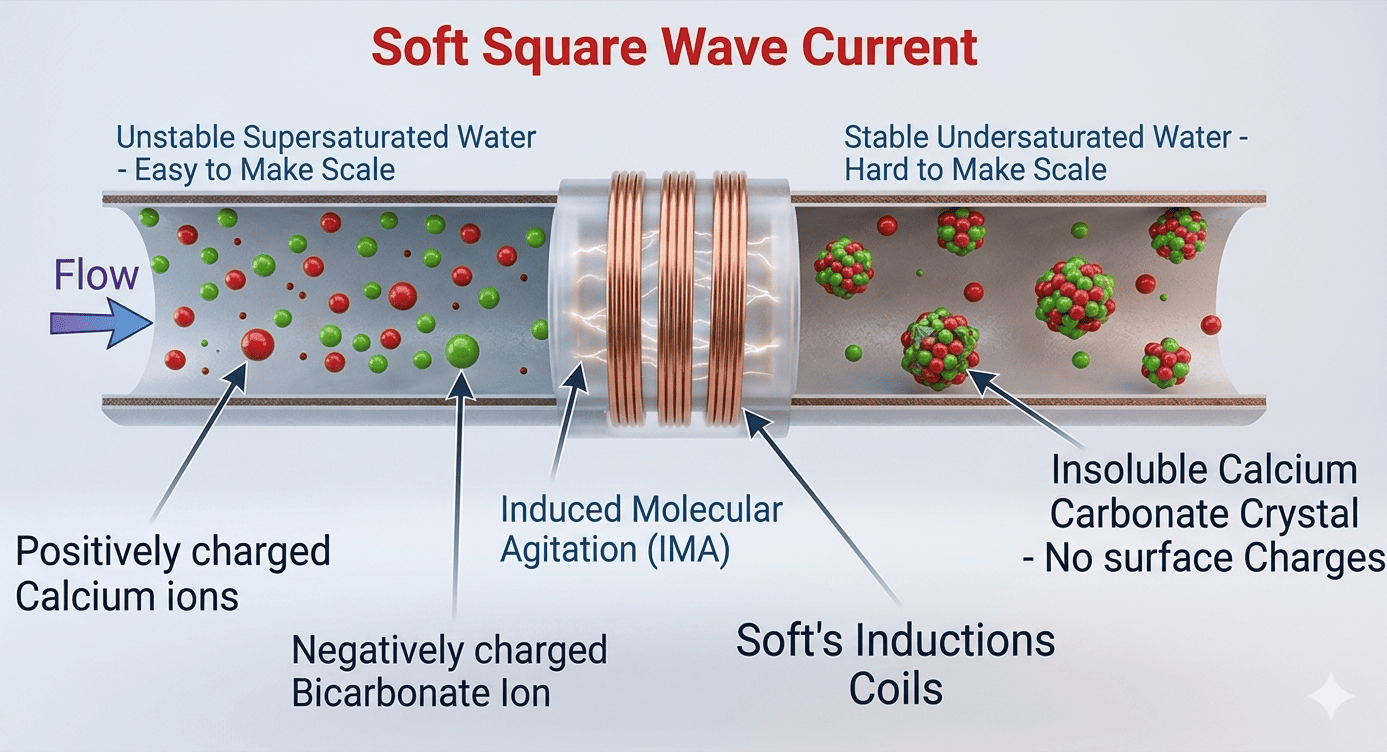
Schematic diagram of a pipe cross-section showing: LEFT (Before) — scattered calcium (red dots) and bicarbonate (green dots) ions in 'Unstable Supersaturated Water'. CENTRE — the Soft Induction Coil providing Induced Molecular Agitation (IMA). RIGHT (After) — ions are clustered into neutral calcium carbonate crystals in 'Stable Undersaturated Water — Hard to Make Scale'.
Induced Molecular Agitation (IMA) — The Snowball Effect
How unstable ions are forced into harmless crystals
The Induced Molecular Agitation (IMA) of our technology causes the unstable mineral ions to precipitate, providing initial nucleation sites for further precipitation of adjacent mineral ions.
A snowball effect starts, resulting in the growth of many crystals, each consisting of numerous mineral ions. These insoluble crystal salts become large in size and float with water — they do not stick to the metal surfaces because the crystals no longer have charges at the surface.
The Process Step by Step:
IMA creates molecular agitation inside the pipe
Unstable, partially hydrated ions begin to collide
Collisions create nucleation sites (first crystals)
Snowball effect — crystals grow by attracting more ions
Large neutral crystals float harmlessly in water
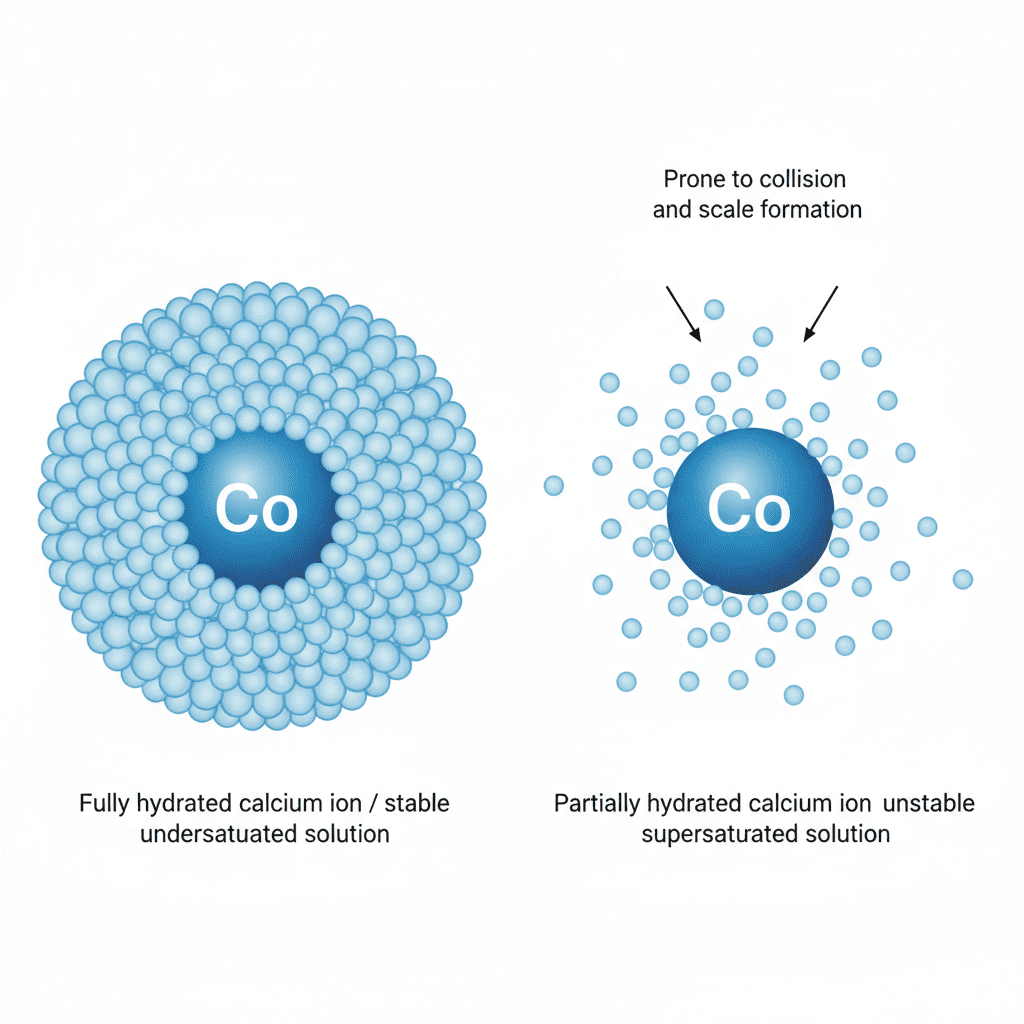
Two side-by-side illustrations of calcium ions. LEFT: 'Fully hydrated calcium ion / stable undersaturated solution' with dense, tightly packed water molecules. RIGHT: 'Partially hydrated calcium ion / unstable supersaturated solution' with sparse, incomplete water molecule shell — making it prone to collision and scale formation.
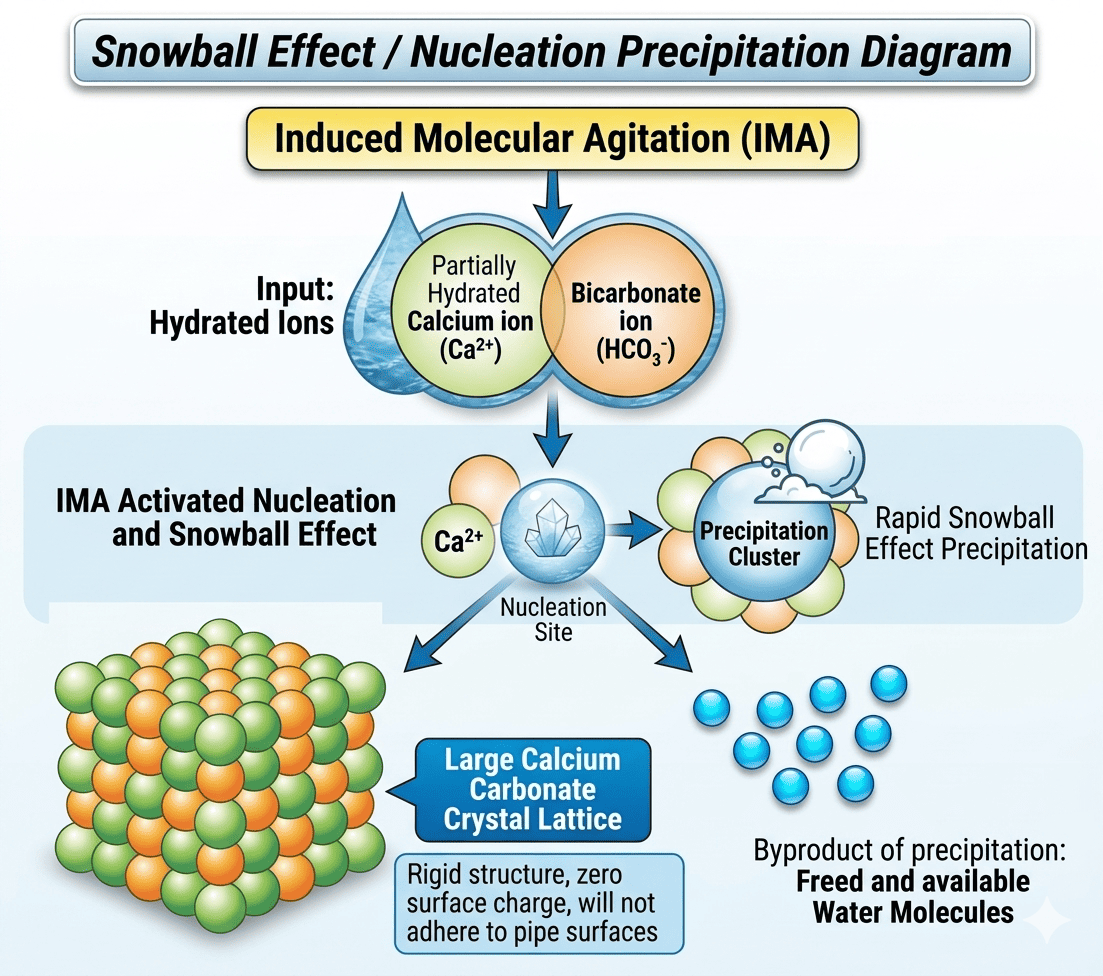
Snowball Effect / Nucleation Precipitation Diagram: Partially hydrated calcium ion + bicarbonate ion → IMA creates nucleation → Snowball effect starts → Large calcium carbonate crystal lattice with no surface charge (no longer sticks to pipe walls). Also shows freed water molecules as by-product.
Free Water Molecules Dissolve Existing Scale
How treated water dissolves existing scale deposits
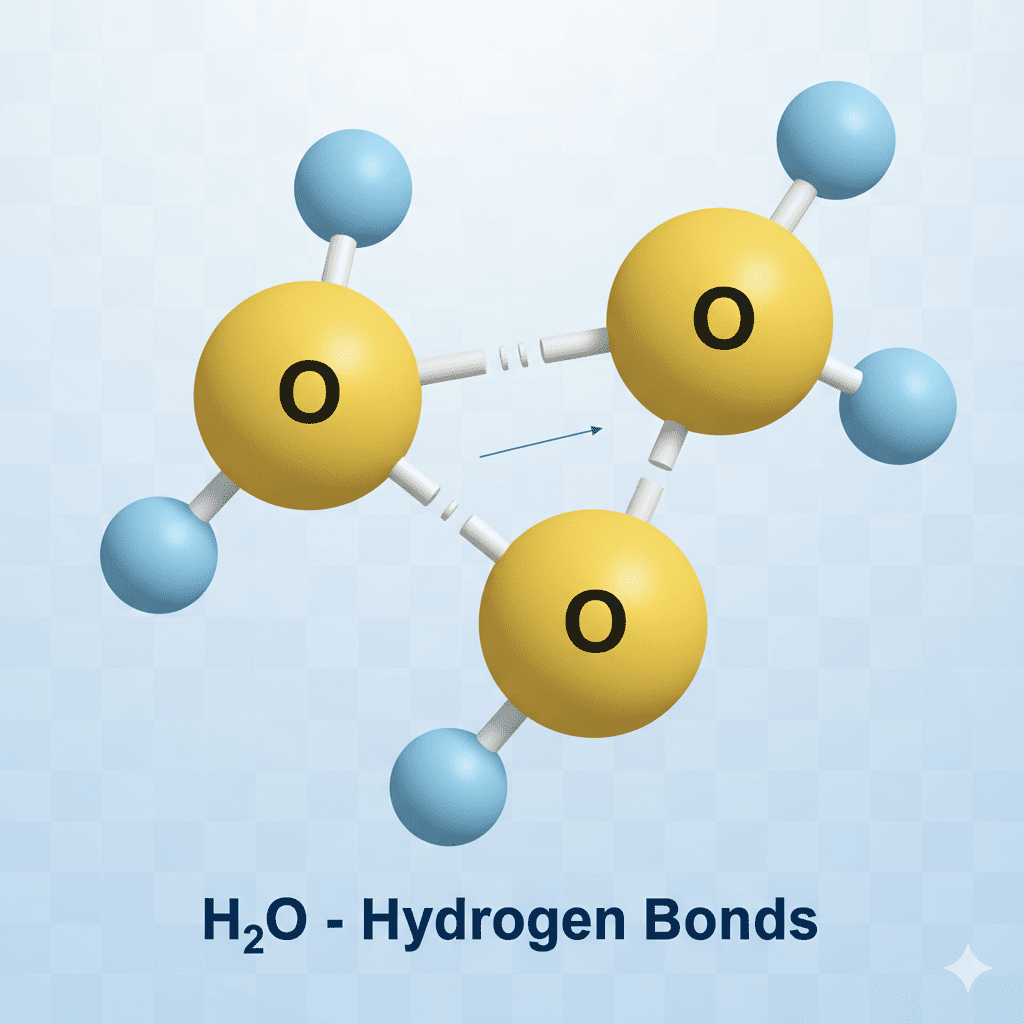
Two water molecules (H₂O) connected by bonds. Each molecule shown as a large yellow sphere (oxygen) bonded to two smaller blue spheres (hydrogen). They are connected at an angle showing the dipole moment and how water molecules lock together in aggregates via hydrogen bonds.
As the by-products of the precipitation and snowball effect, free water molecules become available to dissolve existing scale.
The electronic signal generated through the induction coil breaks apart water molecules with calcium carbonate attached — these become "empty" water molecules that immediately begin to attract calcium molecules from existing scale buildup on pipes throughout the system.
It is well known in water chemistry that most water molecules are locked in aggregates— less than 20% exists as free water molecules. This is because water molecules have a dipole moment: the hydrogen atom is attracted to the oxygen atom of the adjacent water molecule.
Our frequency modulation technology allows the induced electrical agitation to tune to the natural frequency of the water molecules vibrating in the aggregates. Through cooperative resonance, free water molecules become available, dissolving existing scale in the pipe.
Water Molecule Aggregate Treatment
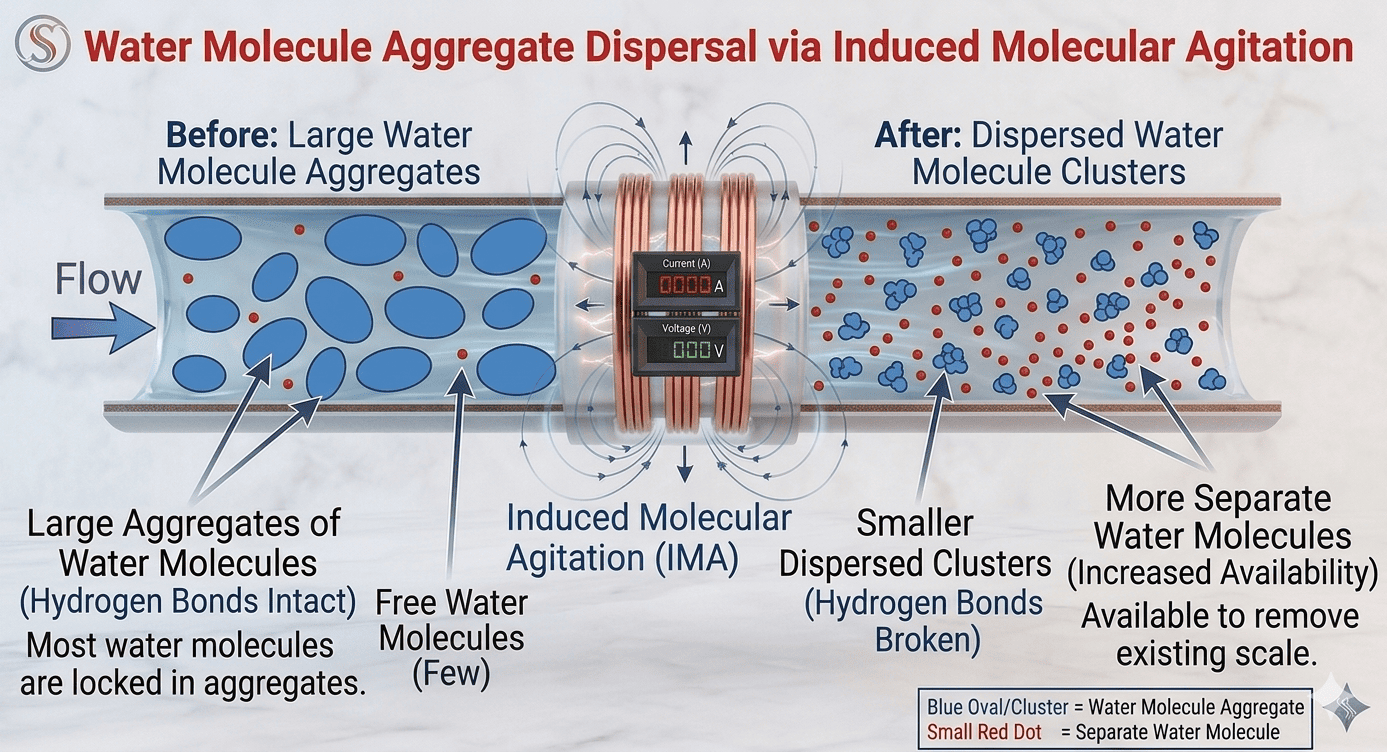
Pipe cross-section diagram showing water molecule behaviour. LEFT (Before): Large blue oval blobs (Aggregates of Water Molecules) mixed with small red dots (Free Water Molecules) — most water molecules are locked in aggregates. CENTRE: Soft Induction Coil with IMA. RIGHT (After): Aggregate blobs broken into smaller clusters — hydrogen bonds are broken, more separate water molecules available to remove existing scale.
The Physical Laws Behind IMA
The well-established physics behind our technology
Ampere's Law
The unit involves a signal cable wound around the outside wall of the pipe, creating a solenoid coil. When current flows through the coil, a magnetic field is produced. The "right-hand rule" determines the direction of this field. The strength is proportional to the product of current and number of turns.
Ampere's Law
B = μ₀ · n · I
Where B = magnetic field vector (Wb/m² or Tesla), μ₀ = permeability of free space, n = coil turns per unit length, I = current (amperes)
Faraday's Law of Induction
Our signal sweeps across a wide spectrum of varying frequency responses at a high-speed, cyclic rate. When the magnetic field varies with time, an induced current is produced inside the pipe. This induced, oscillating electric field provides the molecular agitation necessary for scale prevention and removal.
Faraday's Law of Induction
∮ E·ds = − ∂/∂t ∫ B·dA
Where E = induced electric field vector. The time-varying magnetic field induces an electric field inside the pipe.
Frequency Modulation — The Key to Success
The secret sauce that makes our technology work regardless of conditions
Our signal sweeps across a comprehensive range of frequencies at a rapid, continuous rate. This process is called "frequency modulation".
This frequency modulation is necessary because the precise natural frequency of supersaturated water — where mineral ions are most unstable — is not fixed. Applying a dynamic signal ensures we hit the exact resonance required for the technology to perform effectively, regardless of flow rate and hardness levels.
Dynamic Tuning to Natural Frequency
The natural frequency of supersaturated water critically depends on variables likeviscosity and water temperature.
Since these conditions change constantly, our frequency modulation method"auto-tunes" by scanning the entire range of relevant frequencies multiple times per second. This ensures consistent performance even as water conditions fluctuate.
The complete frequency sweep occurs during the exact time water passes through the treated zone. This high-speed modulation is critical to our success, ensuring every molecule is subjected to the necessary resonance for effective treatment.
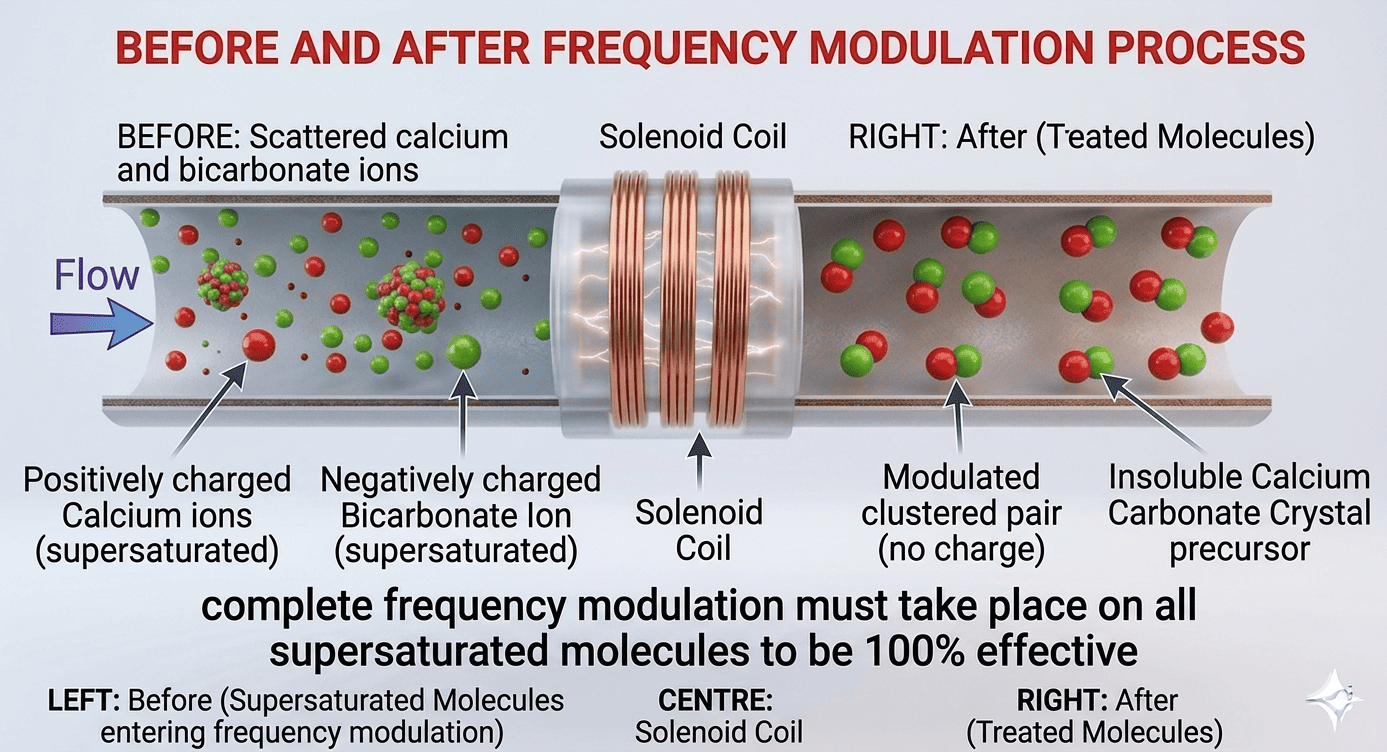
'Before and After' Treatment Zone Diagram showing pipe cross-section. LEFT (Before): Scattered calcium and bicarbonate ions (supersaturated molecules entering the modulation field). CENTRE: Induction Zone. RIGHT (After): Ions grouped into clustered pairs. Caption: Continuous frequency modulation must take place on all supersaturated molecules to be 100% effective.
Professional & Proper Manufacturing Matters
Why factory-engineered precision is essential for maximum effectiveness
The effectiveness of our technology relies on the integrity and precision of the induction coil. The coil configuration is a sophisticated engineering element that determines the strength and uniformity of the induced field inside the pipe.
Unlike primitive systems, our coils are not manual wraps done during installation. Every unit is precision-manufactured in the factory under strict quality control. This ensures the exact number of layers, spacing, and tension required to create a perfect oscillating field for specific pipe diameters.
Professional manufacturing eliminates variables that occur with field-wrapped coils. By integrating the coil design directly into our hardware architecture, we guarantee full treatment coverage and long-term reliability for every application.
The Polar Water Molecule & Hydrogen Bonds
Taking advantage of water's unique polar molecular structure
Our technology takes advantage of the unique characteristics of water — the polar molecule. The positive hydrogen of one water molecule is strongly attracted to the negative oxygen of a neighbouring molecule. This connecting force is the van der Waals force, often referred to as a "hydrogen bond".
In liquid water, there is a mixture of:
Separate individual water molecules (free, effective as solvent)
Aggregates of hydrogen-bonded molecules (locked together, less effective as solvent)
Our self-tuning dynamic induction using frequency modulation automatically tunes to the natural frequencies of vibrating water molecules, producing a resonance that breaks the hydrogen bonds in clusters, freeing water molecules.
Since solubility depends on the number of available separate water molecules, this process dramatically increases the solubility of water — making it a far more effective solvent for dissolving existing scale deposits.
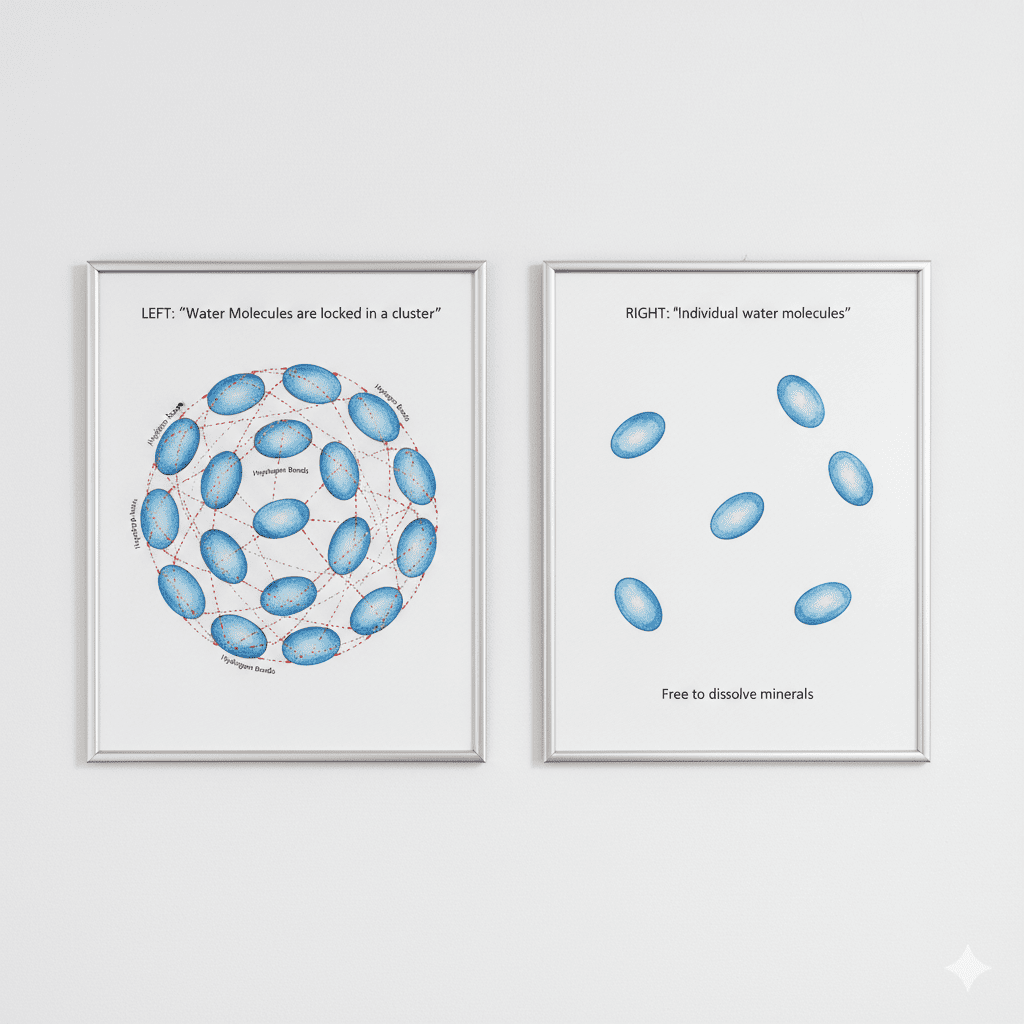
Two side-by-side illustrations. LEFT: 'Water Molecules are locked in a cluster' — 8-10 oval shapes connected in an interconnected network via hydrogen bonds. RIGHT: 'Individual water molecules' — 5-6 oval shapes scattered separately with no connecting lines, representing free water molecules available to dissolve minerals.
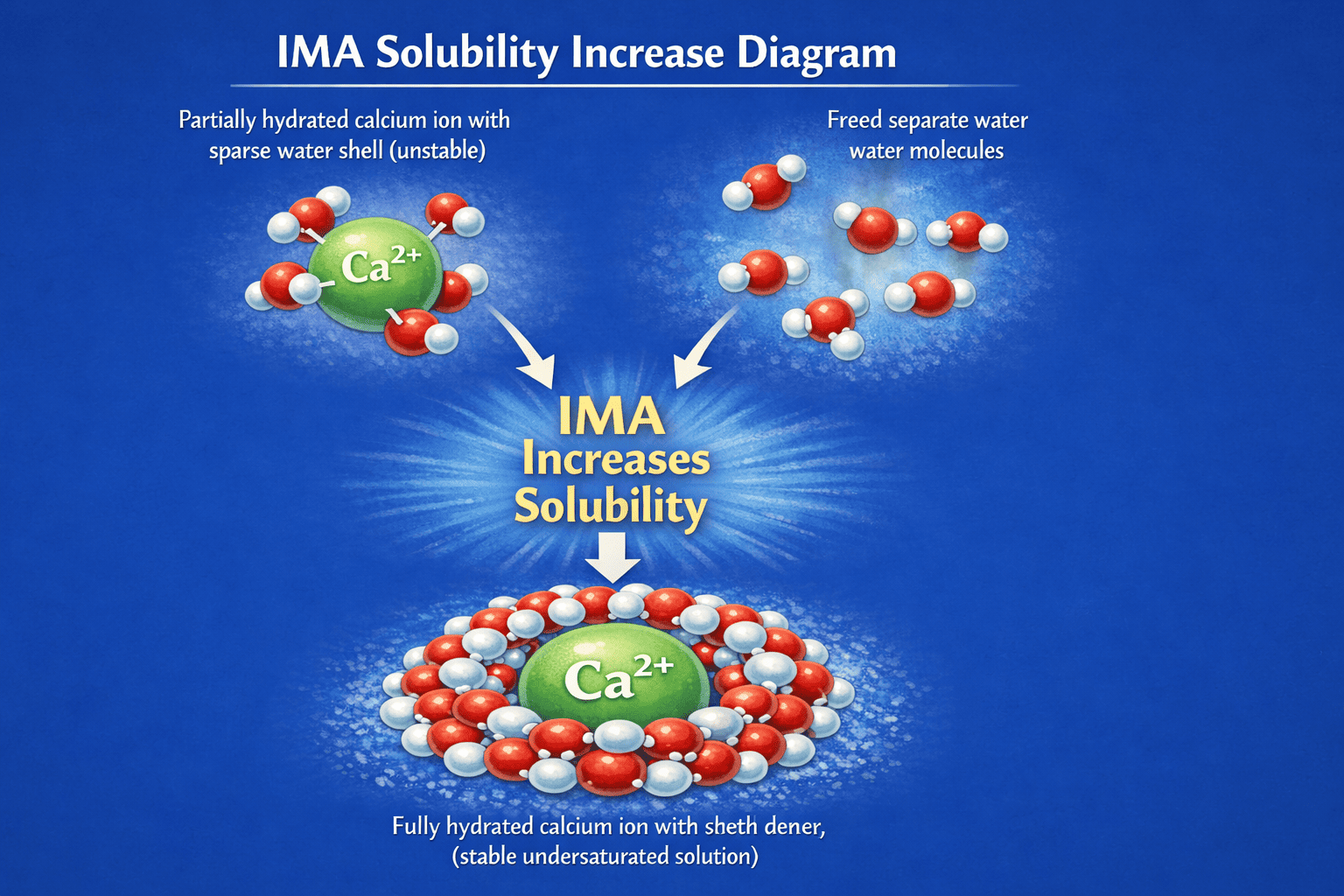
IMA Solubility Increase Diagram: TOP LEFT — Partially hydrated calcium ion with sparse water shell (unstable). TOP RIGHT — Freed separate water molecules. CENTRE — IMA increases solubility. BOTTOM — Fully hydrated calcium ion with dense, complete water shell (stable undersaturated solution).
How the Descaling Process Works
The mechanism that dissolves existing calcium carbonate deposits
❌ Untreated Water
Water molecules are interconnected via hydrogen bonds. They are not readily available to dissolve minerals and chemicals.
✅ Treated Water
The hydrogen bonds are broken, freeing individual water molecules — making them available to dissolve minerals and chemicals.
This is accomplished with a time-varying magnetic field inside the pipe using a wide spectrum of modulated frequencies (Faraday's Law combined with IMA).
The freed water molecules actively surround and dissolve individual calcium carbonate molecules from scale deposits on pipe walls, gradually removing existing scale layer by layer.
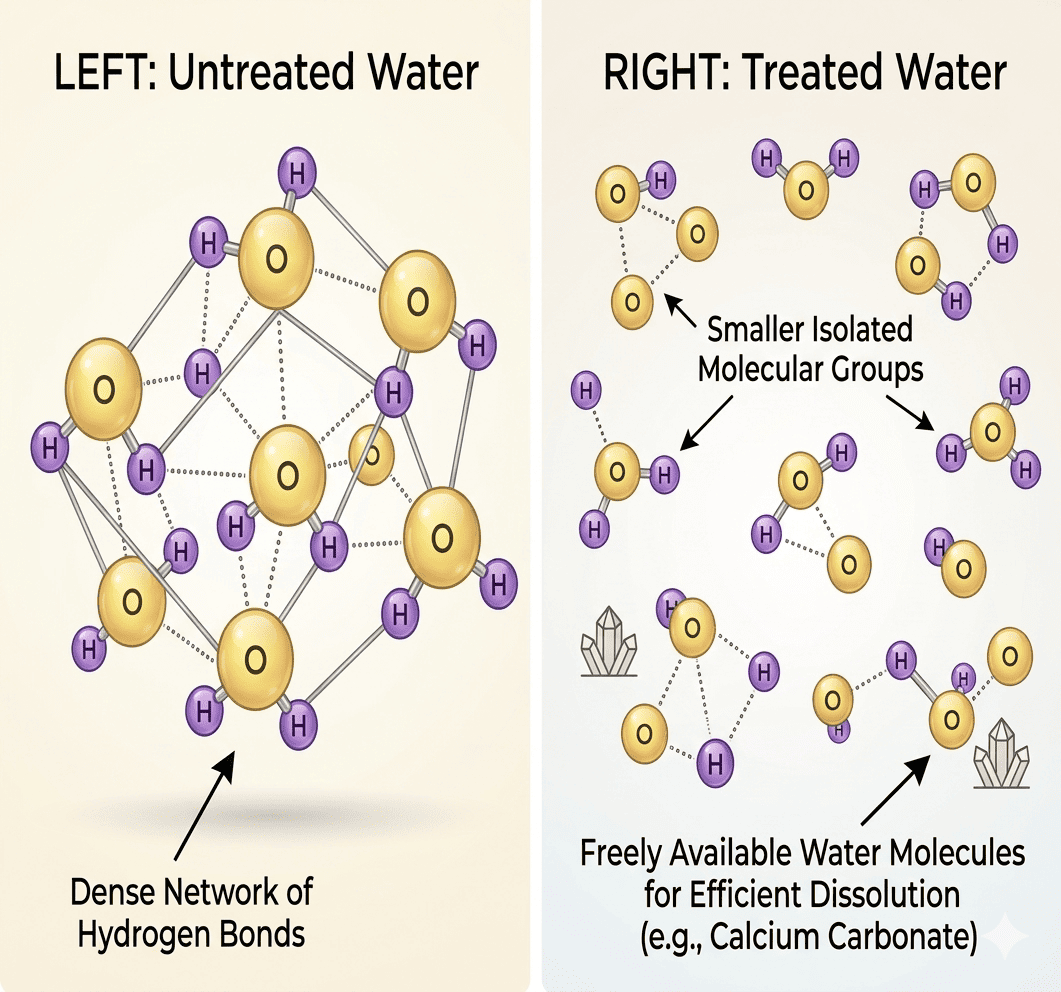
Two-panel comparison: LEFT ('Untreated Water') — water molecules interconnected by hydrogen bonds in a rigid network. RIGHT ('Treated Water') — molecules broken apart into smaller groups of 1–3, scattered and separated, representing freely available water molecules that can dissolve calcium carbonate.
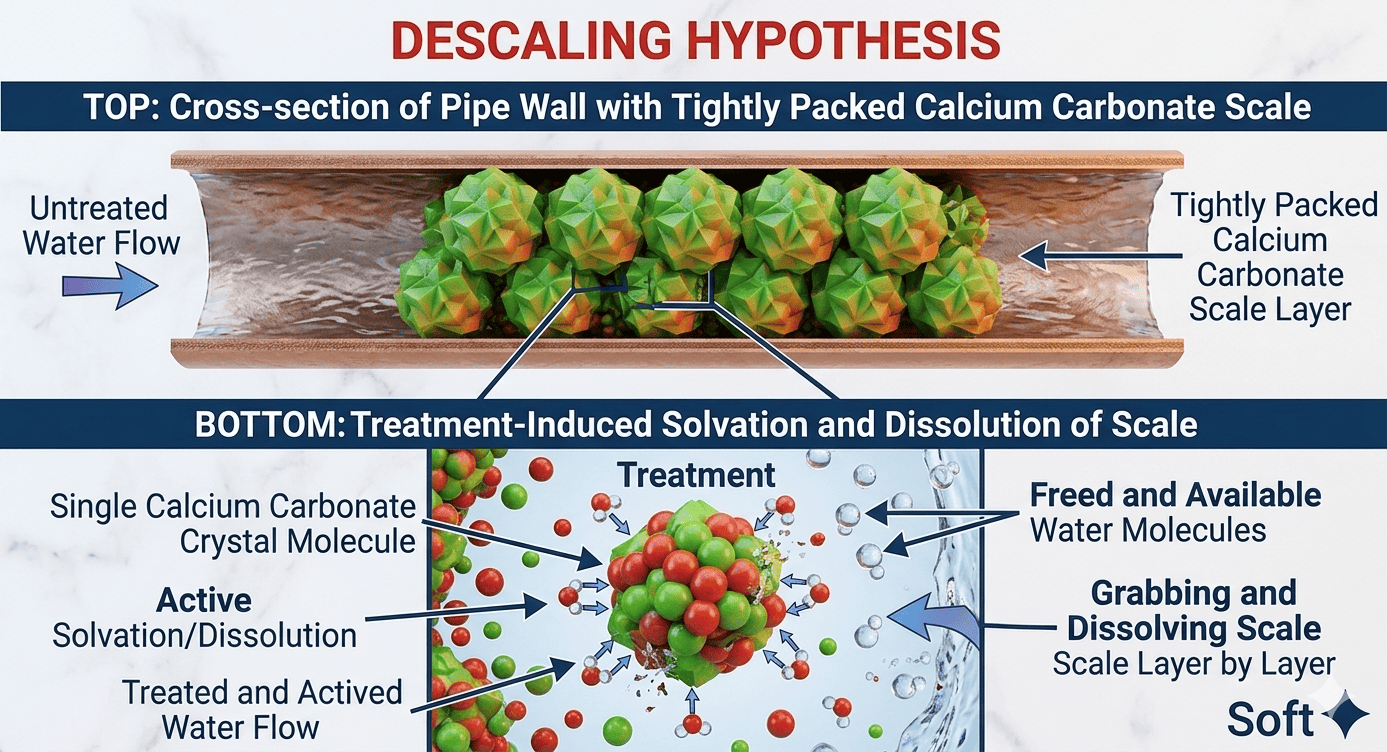
Descaling Hypothesis: TOP — Cross-section of pipe wall with tightly packed calcium carbonate scale layer. BOTTOM — A calcium carbonate molecule surrounded by freed water molecules performing solvation/dissolution, labelled 'with treatment'. This shows how freed water molecules grab and dissolve scale layer by layer.
Resonance Breaks the Hydrogen Bond
The mechanism at the heart of our technology
The mechanism of breaking the hydrogen bond is resonance!
When the external disturbance provided by our technology matches the natural frequencyof the hydrogen atom, the hydrogen bonds are broken instantly.
It is important that the frequency range exceeds the best estimate of the internal natural frequency of water — because this natural frequency can vary with:
Many experts have established that the internal frequency of water falls within a distinct vibrational band. Our technology is engineered to sweep this entire range completely using high-speed modulation.
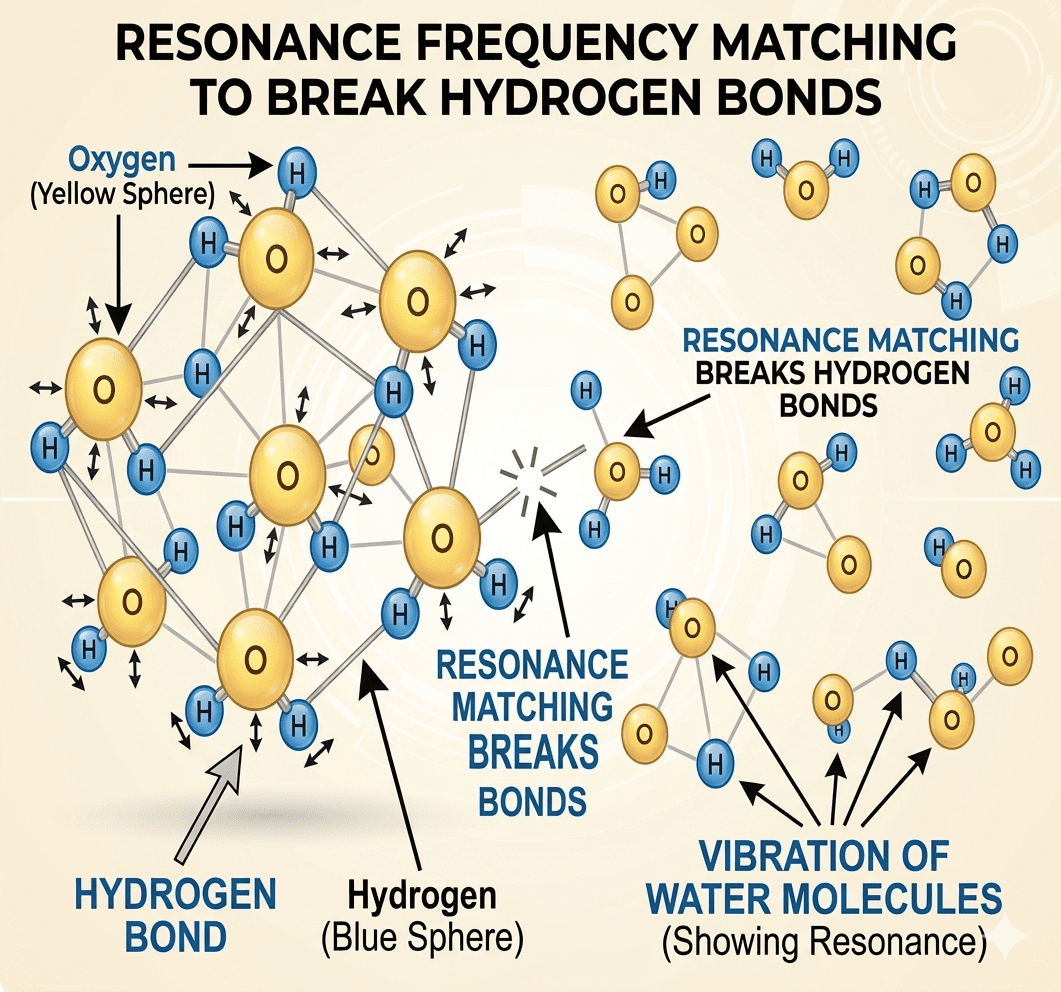
Detailed molecular diagram showing 6 water molecules (yellow oxygen + blue hydrogen) interconnected by hydrogen bonds in a lattice pattern. Each molecule has double-headed arrows (↔) showing vibration. Labels point to 'Hydrogen bond' (connecting lines) and 'Vibration of water molecules' (the arrows). This illustrates resonance frequency matching that breaks hydrogen bonds.
IMA Process Summary
The complete overview of the IMA process
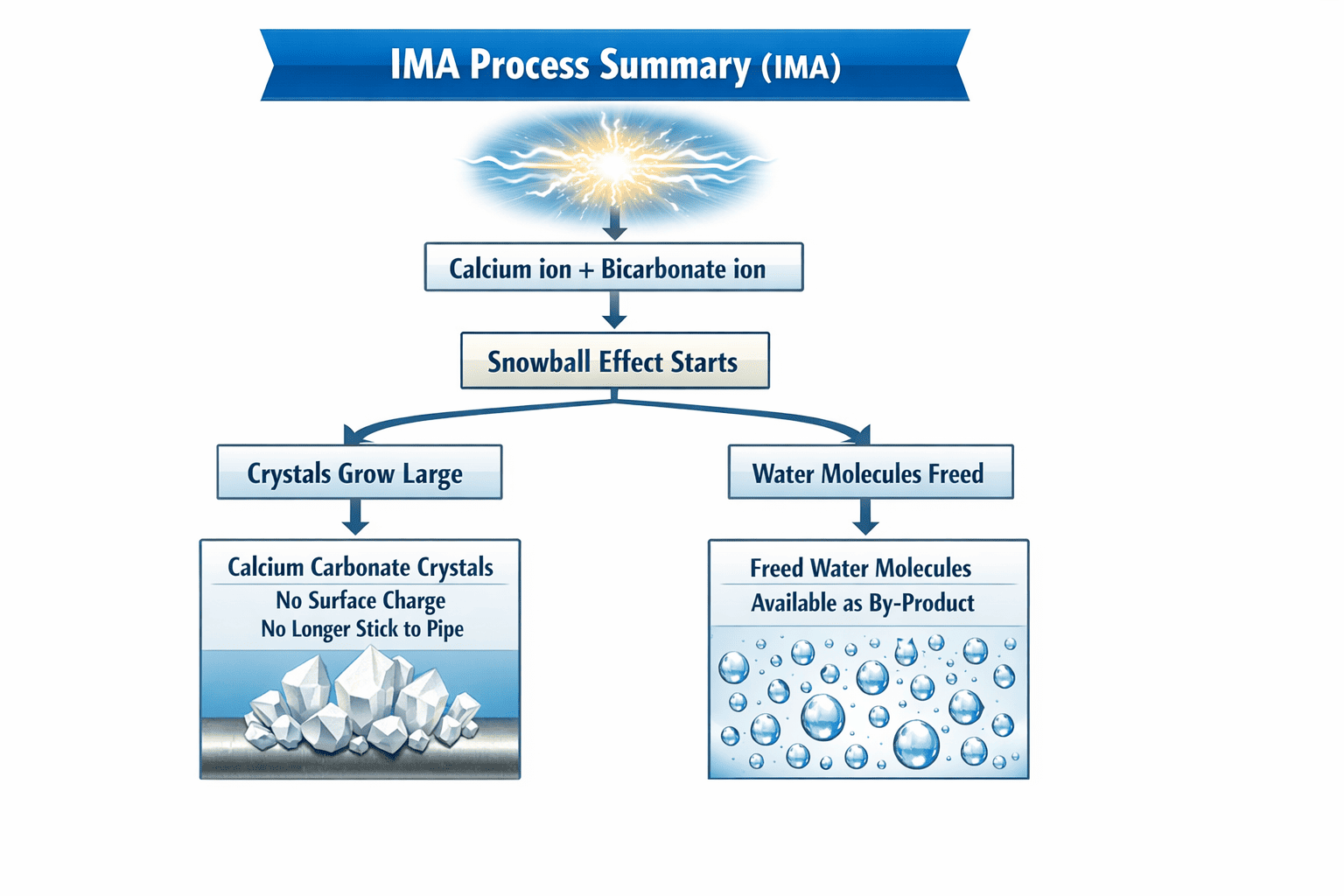
Complete IMA Process Summary Flowchart: TOP — 'Induced Molecular Agitation (IMA)' trigger. MIDDLE — Calcium ion + Bicarbonate ion brought together. Then 'Snowball effect starts' branching into TWO outcomes: LEFT — Calcium carbonate crystals grow large with no surface charge (no longer stick to pipe). RIGHT — Freed water molecules become available as by-product. This shows the dual-outcome of IMA technology.
Two Simultaneous Effects, One Powerful Solution
Effect 1: Crystal Precipitation
IMA creates nucleation sites, initiating the "snowball" effect. Suspensions of soft, less-adherent calcium carbonate crystals form, removing dissolved calcium and bicarbonate ions from the supersaturated solution. These neutral crystals float harmlessly with water.
Effect 2: Hydrogen Bond Breaking
IMA breaks hydrogen bonds in aggregates of liquid water, freeing water molecules. More free water molecules means increased solubility. The unstable supersaturated solution becomes stable, preventing scale and gradually dissolving existing deposits.
Our technology applies a frequency-modulation square-wave current across a comprehensive range of dynamic frequencies, creating the precise molecular agitation needed for both scale prevention and removal.